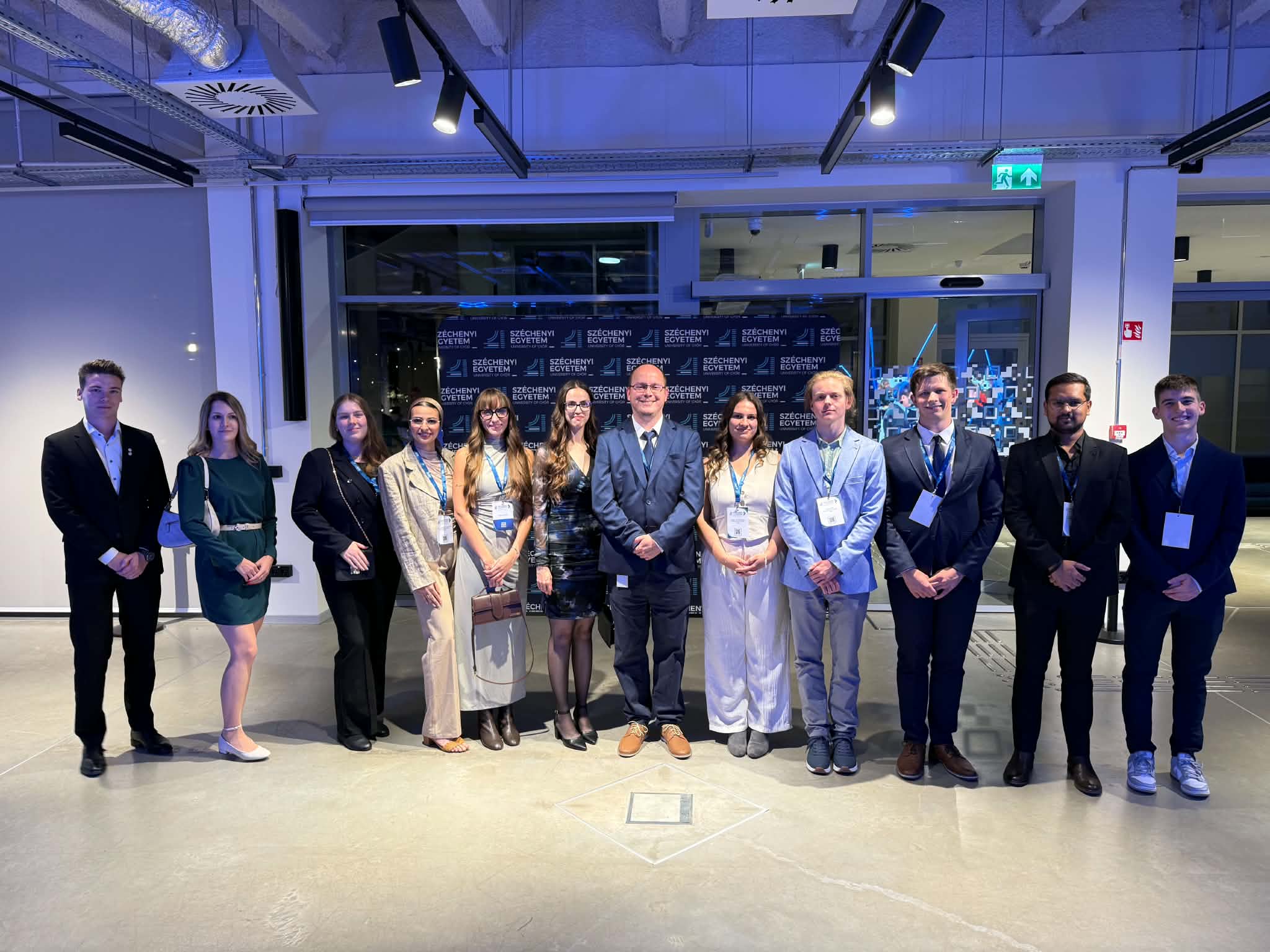
Members of the Széll Kálmán Student association: András Aschenbrenner, Viktória Varga, Anna Szaniszló, Nour Alasasfah, Antónia Payer, Patrícia Horváth, Dr. László Buics, Lili Kinga Balogh, Gábor Pék, Patrik Eszes, Abishae Noel, Péter Mesterházy
The Kautz Conference on Business and Economics provided three inspiring days of scientific exchange, professional discussions, new connections, and academic development at the Kautz Gyula Faculty of Business and Economics of Széchenyi István University. For the Széll Kálmán International Scientific Student Association, the conference was particularly memorable, with an outstanding number of our young researchers presenting their work and several members receiving Best Presenting Author Awards.
The conference offered an excellent opportunity for academics, researchers, professionals, and students to meet, exchange ideas, discuss current research questions, and establish the foundations for future collaborations. We are especially grateful to the Kautz Gyula Faculty of Business and Economics and Széchenyi István University for providing such a warm, engaging, and professionally stimulating environment for the scientific community.
For our Association, however, the greatest source of pride was seeing so many of our members take their place in this environment—not simply as spectators, but as active contributors to the scientific dialogue.
Our young researchers representing SZKSZ
One of the central goals of the Széll Kálmán International Scientific Student Association is to create a pathway through which talented students can gradually develop from interested university students into confident young researchers. Conference participation is an essential part of this process: students have the opportunity to present their findings, receive professional feedback, answer questions, exchange perspectives with researchers from different fields, and become active members of the wider academic community.
At this year’s Kautz Conference, our members presented research across an exceptionally diverse range of contemporary economic, business, technological, sustainability, and social topics.
Kinga Lili Balogh presented “Waste-free Dialogue: Communication Tools for Mitigating Food Waste in Higher Education,” examining communication approaches related to reducing food waste within the higher education environment.
Viktória Varga contributed with “Talent Support and Competence Development in Higher Education: A Q-Methodology Study,” bringing the topic of talent development itself into the scientific discussion.
Gábor Pék presented “Factors Influencing the Intention and Actual Use of Escooters in the Context of Sustainable Urban Mobility,” addressing the increasingly important relationship between individual mobility choices and sustainable urban transportation.
Anna Szaniszló presented “What Influences Environmentally Conscious Behavior? An Empirical Research with more than 500 Students,” exploring the factors behind environmentally responsible behaviour through a large-scale student study.
Péter Mesterházy introduced his research titled “AI-Supported Customer Service Process Optimization in Public Services: A Simulation-Based Approach to Efficiency and Sustainability,” connecting artificial intelligence, process development, public services, and sustainability.
Pongrác Dús presented a “Systematic Literature Review on Social Impact Bonds,” examining the existing scientific knowledge surrounding this increasingly relevant financial and social policy instrument.
Noémi Szabó presented “Plugging Into Trust: Exploring AI and the Human Side of EV Acceptance in Hungary by a Mixed-method approach,” investigating the interaction between artificial intelligence, trust, and the acceptance of electric vehicles.
Lahbib Maissa contributed with “Virtual Teams as Socio-Technical Systems: An Integrative Systematic Literature Review of Success Factors and Barriers,” examining the factors supporting and hindering effective virtual teamwork.
Matthew Boota presented “A Systematic Literature Review of Data Exchange in Digital Supplier Buyer Communication in Transportation and Logistics,” focusing on digital information exchange within contemporary transportation and logistics relationships.
Md Abdullah Al Mamun presented “Enacting Common Good Human Resource Management for Social Sustainability: A Multi-Level Narrative Inquiry,” connecting human resource management practices with broader questions of social sustainability.
Nour Alasasfah presented “Beyond the Classroom: Exploring AI Use, Perceptions, and Educational Impact Among Students and Teachers in Secondary and Higher Education,” addressing one of the most rapidly developing questions in education: how artificial intelligence is perceived and used by students and educators.
Csenge Kálmán and András Aschenbrenner jointly presented “Artificial Intelligence in Project Management: Insights from Literature and Practice,” connecting the rapidly developing field of AI with contemporary project management.
Patrik Eszes presented “Integrating Demand Responsive Transportation into the Smart City Concept: Implications for possibilities within development and research in The European Union – A Mixed-Method approach,” focusing on the relationship between smart cities, demand-responsive transportation, and future European mobility development.
Antónia Payer presented “The Role of Sustainable Mobility and Urban Logistics Systems in Smart City Ecosystems – A Mixed Method Approach,” examining how mobility and urban logistics contribute to the development of sustainable smart-city ecosystems.
Finally, Abishae Noel presented “Exploring Collaborative Artificial Intelligence in Urban Mobility and Logistics Systems: A Mixed-Methods Review,” connecting collaborative artificial intelligence with the future development of mobility and logistics systems.
The diversity of these research areas demonstrates an important characteristic of our community. While our members work on very different problems, they share a common willingness to ask relevant questions, apply scientific methods, challenge themselves, and contribute new knowledge to their respective fields.
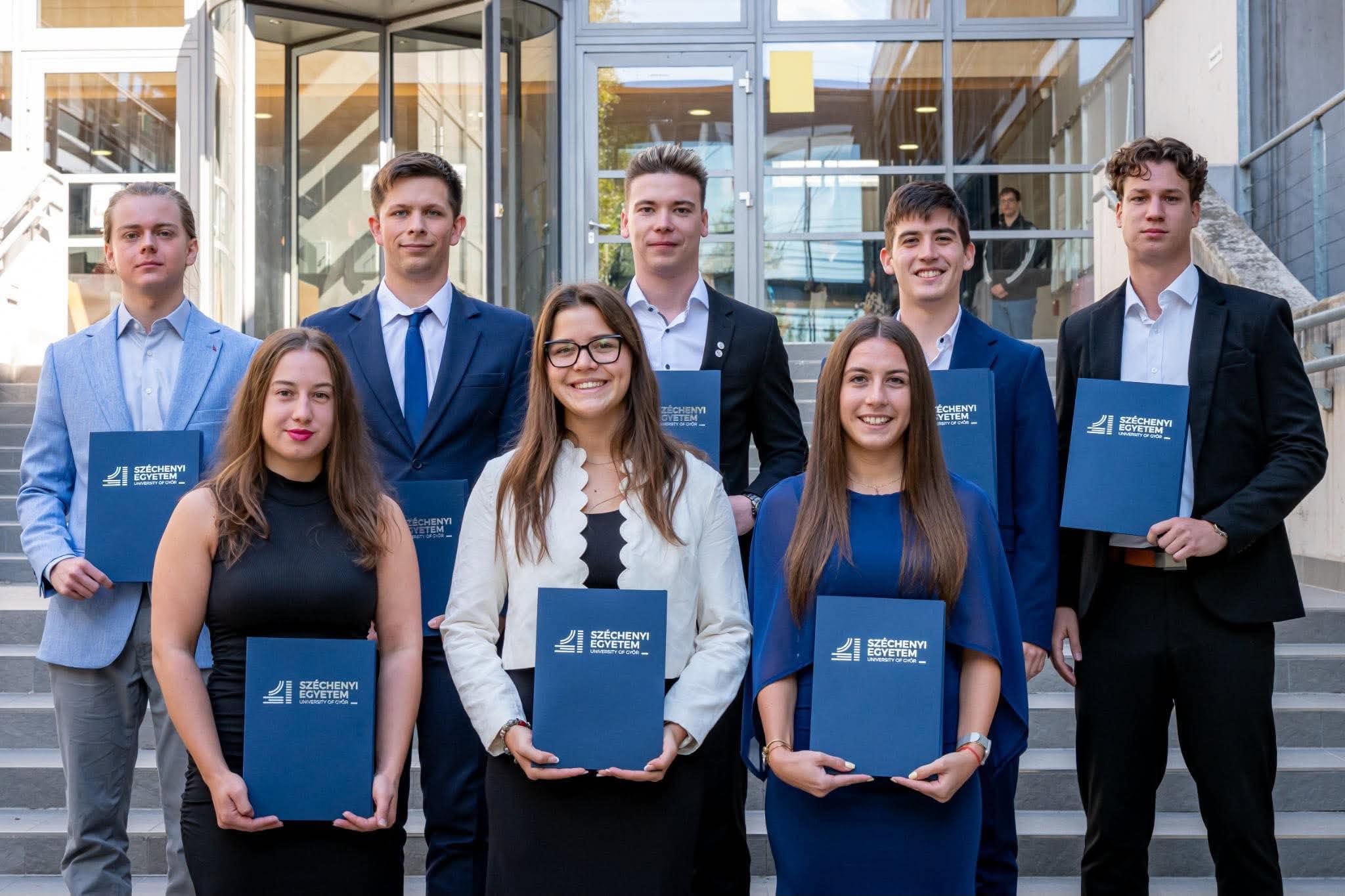
Four Best Presenting Author Awards for our members
The strong scientific presence of our students was further recognized during the conference, as four SZKSZ members received Best Presenting Author Awards in their respective sessions:
🏆 Patrik Eszes
🏆 Noémi Szabó
🏆 Pongrác Dús
🏆 Csenge Kálmán
We are immensely proud of all four award recipients. These recognitions are particularly meaningful because successful conference participation requires much more than conducting quality research. Young researchers must also learn how to communicate complex ideas clearly, structure their arguments, engage an audience, respond to questions, and confidently defend their research decisions.
At the same time, while we celebrate these awards, we are equally proud of every member who stood in front of an academic audience and presented their work. Reaching this stage already represents months of research, preparation, learning, revision, and perseverance.
More than presentations: our talent development philosophy in practice
The achievements of our members at the Kautz Conference closely reflect the values and goals upon which the Széll Kálmán International Scientific Student Association has built its talent development activities.
Our objective is not simply to encourage students to attend additional programmes alongside their university studies. We aim to create a research-oriented student career model through which motivated students can progressively develop their academic, professional, and personal competencies, while gradually becoming independent young researchers and active members of the scientific community.
Scientific research, TDK and OTDK participation, publications, conferences, research methodology training, mentoring, case study competitions, international opportunities, professional networking, and student leadership are therefore not separate activities. Together, they form a developmental pathway in which one experience prepares students for the next challenge.
As Dr. László Buics, Program Director of the Association, highlighted:
“For us, talent development is not about organizing individual programmes, but about building a pathway. We want our students to progress from taking their first steps in research to presenting at conferences, publishing their results, competing internationally, and eventually becoming confident, independent young professionals and researchers. Seeing so many of our members standing in front of an academic audience at the Kautz Conference—and seeing the quality and confidence with which they represented their work—is one of the best demonstrations that this model is working.”
Conference participation represents a particularly important step in this journey. Research leaves the desk and becomes part of a wider professional conversation. Students learn that scientific work does not end when a paper is completed: knowledge gains value when it is communicated, questioned, discussed, refined, and shared with others.
The four Best Presenting Author Awards provide particularly visible recognition of this development, but the broader achievement goes far beyond the awards themselves. Every student who prepared a scientific contribution, presented it before a professional audience, responded to questions, and engaged with fellow researchers took another important step in their own academic development.
Seeing so many of our members confidently participating in this process at the Kautz Conference is therefore one of the clearest demonstrations of what we hope to achieve as an Association: measurable talent development built on opportunity, mentoring, continuous challenge, increasing independence, and a strong scientific community.
Contributing both on stage and behind the scenes
We are also especially proud that SZKSZ members contributed to the success of the conference beyond their own research presentations.
Organizing a multi-day international scientific event requires enormous preparation, coordination, communication, and attention to detail. While participants primarily experience the presentations, discussions, and networking opportunities, a significant amount of work takes place behind the scenes to make these experiences possible.
Our members Antónia Payer and Dániel Biczi supported the conference organizers in coordinating the event, with Antónia additionally contributing as a conference secretary.
Their involvement represents another value that is particularly important within our Association: being part of an academic community also means contributing to that community.
We are proud that our members were present not only as researchers presenting their own achievements, but also as colleagues willing to take responsibility and help create a positive experience for others.
Thank you for three inspiring days
The 3rd Kautz Conference on Business and Economics was much more than a series of presentations. It created a space for meeting like-minded people, exchanging research ideas, discovering new perspectives, developing future projects, and strengthening existing professional relationships.
We would therefore like to express our sincere appreciation to the Kautz Gyula Faculty of Business and Economics and Széchenyi István University for hosting such a welcoming and engaging scientific event and for creating an environment in which experienced academics and the next generation of researchers could meet, learn from one another, and build new professional connections.
Most importantly, our sincere thanks go to the organizers, coordinators, session chairs, secretaries, faculty members, and everyone working behind the scenes. Events of this scale are only possible through considerable preparation, dedication, and teamwork, and we are grateful for the professional and welcoming environment they created throughout the three days.
And finally, to our students: we could not be prouder of you.
Whether you presented your research, received an award, supported the organization, asked questions, exchanged ideas with fellow researchers, or simply took another step toward becoming an independent researcher, you represented the spirit and values of our Association.
The conference may have ended, but the conversations, ideas, connections, and research journeys continue. We leave the 3rd Kautz Conference not only with awards and memories, but also with new inspiration, professional relationships, and ideas for future research and collaborative projects.
We are already looking forward to seeing where they lead next.