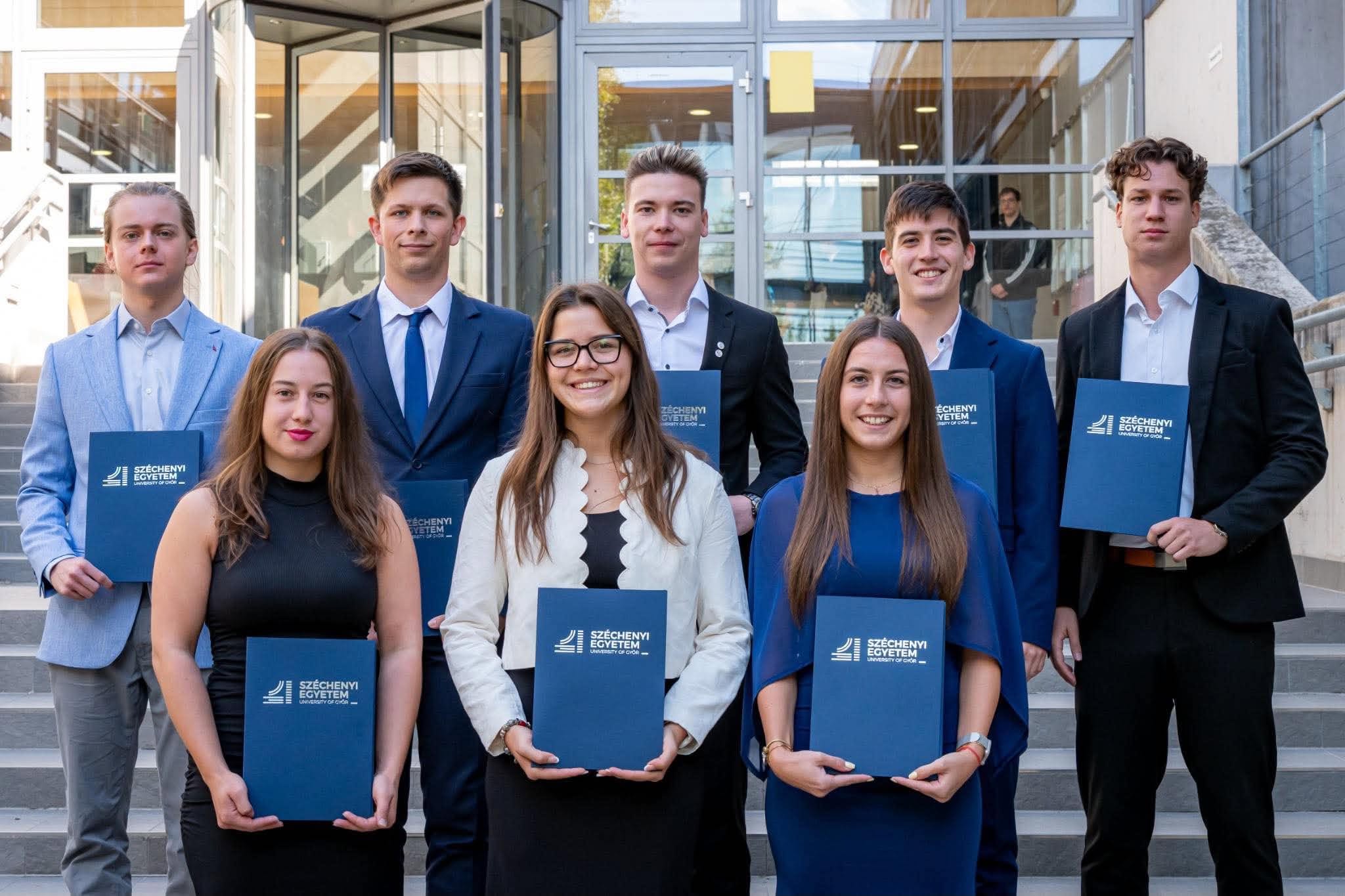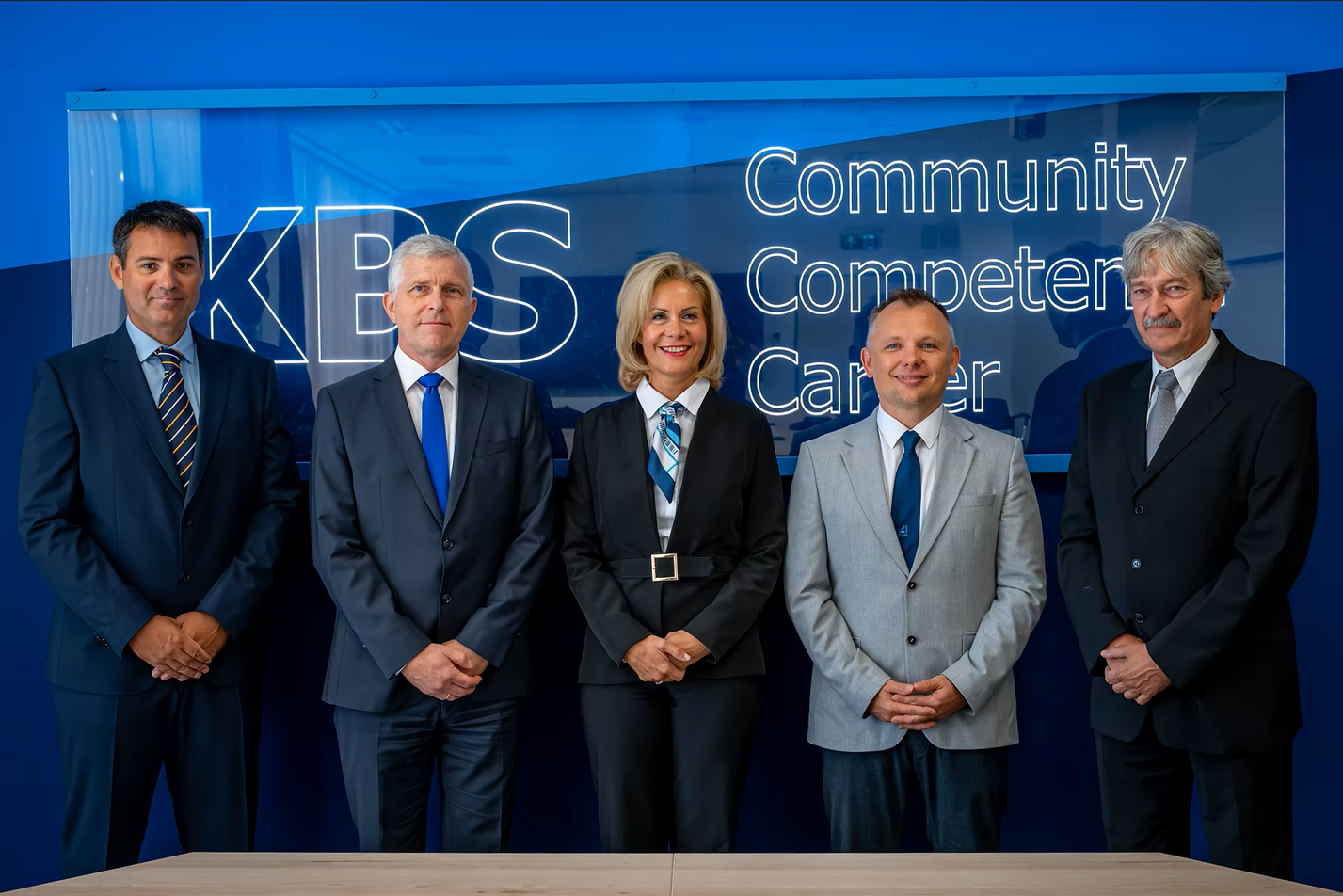
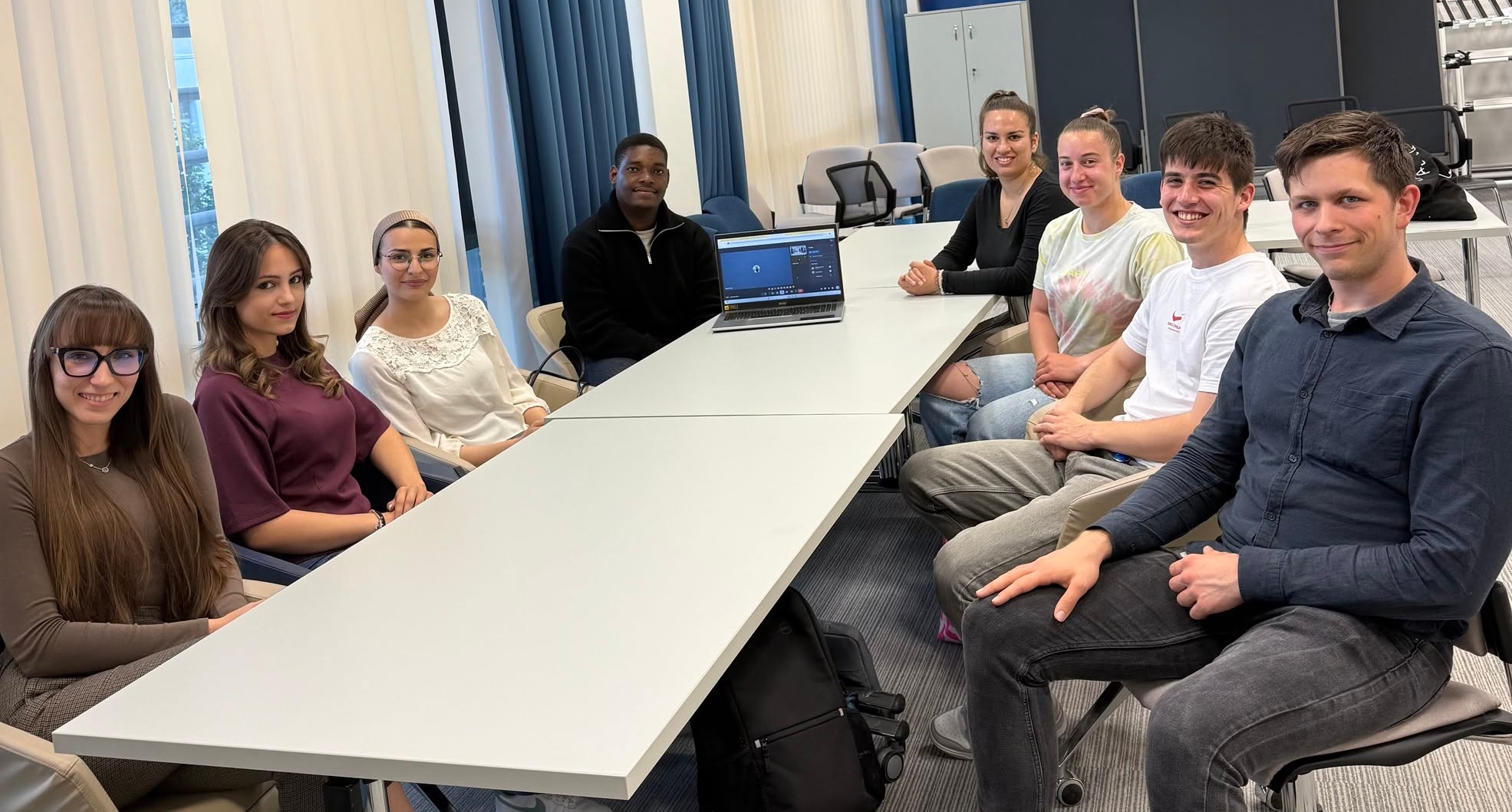
Antónia Payer (left), Patrik Eszes (right), and other members of the management team of the Széll Kálmán Vocational College (Antónia Bánfi-Fisher, Nour Alasasfah, Eric Sumane, Kinga Lili Balogh, Kata Pataki, Péter Mesterházy)
The Széll Kálmán International Scientific Student Association of the Kautz Gyula Faculty of Business and Economics, Széchenyi István University has reached another remarkable milestone in its research-oriented talent development activities. Two of its members—a bachelor’s student and a master’s student—have successfully published their research in internationally recognized Scopus Q1 journals, demonstrating the strength of the Association’s scientific mentoring programme and its commitment to developing the next generation of researchers.
Patrik Eszes, a bachelor’s student and member of the Association, published his research in Logistics (Scopus Q1) under the title “Integrating Demand-Responsive Transportation into Smart City Strategies: Implications for Sustainable Urban Mobility in the European Union—A Systematic Literature Review and Survey Analysis.”
His study investigates the relationship between smart city development and demand-responsive transportation, examining how flexible mobility systems can contribute to more sustainable urban transport across the European Union. Combining a systematic literature review with survey analysis, the research identifies future opportunities for integrating innovative mobility solutions into smart city strategies.
At the same time, Antónia Payer, a master’s student and member of the Association, published her research in Sustainability (Scopus Q1) under the title “Sustainability Challenges of the Interior Design Supply Chain Processes—A Mixed Method Approach with Critical Incident Technique.”
Her research explores sustainability challenges within procurement and supply chain management processes in the interior design industry. Using a mixed-method approach that combines a systematic literature review, Critical Incident Technique interviews, and questionnaire-based research, the study provides new insights into the environmental, operational, and economic challenges companies face when implementing sustainable supply chain practices.
Both publications were prepared in close collaboration with Dr. László Buics, Associate Professor at the Kautz Gyula Faculty of Business and Economics and Program Director of the Széll Kálmán International Scientific Student Association, within the Association’s structured research mentoring programme.
The publications are not isolated achievements but the latest examples of a long-term, systematic talent development model that encourages students to engage in scientific research from the earliest stages of their university studies. Through research methodology training, mentoring, conference participation, publication opportunities, and case study competitions, the Association provides a complete academic development pathway that enables students to produce internationally recognized scientific work while still pursuing their degrees.
Since its foundation, members of the Association have produced more than 150 TDK and OTDK presentations, numerous scientific publications, including numerous papers published in Q1, Q2, Q3, and Q4 international journals, while representing the University at 59 national and international scientific conferences. Alongside these achievements, Association members have also earned outstanding results at national and international case study competitions, further demonstrating the effectiveness of its integrated talent development model.
According to Dr. László Buics, these latest publications represent much more than individual academic success.
“Our goal is not simply to supervise theses, but to create opportunities for students to become active contributors to international scientific knowledge. Publishing in Q1 journals while still studying at university is an outstanding achievement that reflects months of dedicated research, critical thinking, and close cooperation between students and supervisors. These successes demonstrate that scientific excellence is not a matter of chance—it is the result of a structured talent development model, continuous mentoring, and the exceptional commitment of our students. They also reflect the strength of the scientific community we have built within the Széll Kálmán International Scientific Student Association.”
The achievements further strengthen the scientific reputation of both the Kautz Gyula Faculty of Business and Economics and Széchenyi István University, while demonstrating how a research-oriented student association can successfully contribute to scientific excellence, international visibility, and the education of future researchers and professionals.